How Does a SMA Nitinol Spring Activate Without Power?
2026-02-02 21:05:28
Imagine a spring that returns to its original shape without batteries, motors, or electricity—just by changing temperature. This isn't science fiction; it's the reality of sma nitinol spring technology. If you're designing automated systems, medical devices, or robotics that demand reliable actuation in power-limited environments, understanding how these Shape Memory Alloy components work without external power sources could revolutionize your approach to engineering challenges.
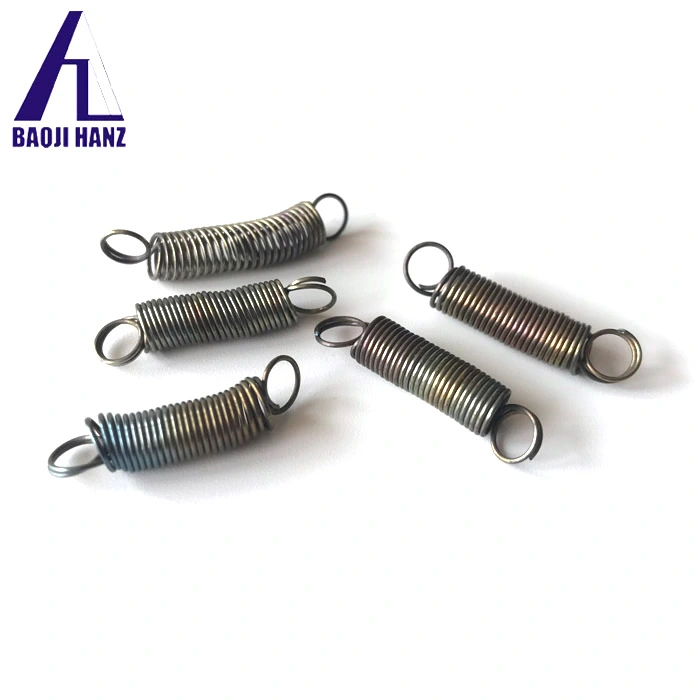
Understanding the Fundamental Mechanism of SMA Nitinol Spring Activation
The remarkable ability of a sma nitinol spring to activate without external power stems from its unique crystalline structure and the shape memory effect inherent in nickel titanium alloy materials. At the molecular level, these springs undergo a reversible phase transformation between two distinct crystal structures: martensite at lower temperatures and austenite at higher temperatures. When the material is in its martensitic state, it remains soft and easily deformable, allowing the spring to be compressed or extended with minimal force. However, when heat is applied—whether from ambient temperature changes, body heat, or warm water—the alloy transforms into its austenitic phase, causing the spring to return forcefully to its pre-programmed shape. This transformation occurs at specific temperatures defined during manufacturing, particularly the Af temperature range of -20℃ to 100℃, which can be customized based on application requirements. The Shape Memory Alloy SMA Nitinol Spring doesn't require continuous power input because the thermal energy from its environment provides sufficient activation energy for the phase transformation. This makes these springs exceptionally valuable in applications where electrical power is unavailable, unreliable, or undesirable, such as in hermetically sealed environments, remote locations, or situations requiring electromagnetic interference immunity.
The Role of Nickel Titanium Alloy Composition
The specific composition of the sma nitinol spring, typically containing a minimum of 54% nickel balanced with titanium, plays a crucial role in determining its transformation temperatures and mechanical properties. The Ti-Ni alloy's intermetallic compound creates the foundation for both shape memory effect and superelasticity. During the production process of sma nitinol spring—from raw material preparation through forming processing, heat treatment and shaping, surface treatment, and finished product inspection—precise control over alloy composition ensures consistent performance characteristics. The material exhibits a density of 6.45g/cm³ and can be manufactured with wire sizes ranging from 0.5mm to 3mm, allowing for spring customization that meets diverse industrial requirements while maintaining the fundamental power-free activation capability.
Temperature-Driven Phase Transformation Mechanics
The activation mechanism of a sma nitinol spring centers on the temperature-dependent phase change between martensite and austenite crystal structures. When the spring temperature rises above its austenite finish temperature, the alloy undergoes a coordinated atomic rearrangement that generates significant recovery forces. This transformation is not gradual but occurs relatively quickly once the critical temperature threshold is reached, providing rapid actuation response. The transformation temperatures can be precisely engineered during heat treatment processes, with AF temperatures customizable between -20℃ and 10℃ for standard applications, though specialized variants can function across broader ranges up to 100℃. This precise temperature control means engineers can design systems where the sma nitinol spring activates at exactly the right moment without sensors, controllers, or power supplies.
Applications and Advantages of Power-Free SMA Nitinol Spring Systems
The power-independent activation of sma nitinol spring technology opens extraordinary possibilities across multiple industries. In aerospace applications, these springs serve as fail-safe mechanisms that deploy automatically when temperature conditions change, such as releasing deployment systems when spacecraft enter different atmospheric layers. Medical devices benefit tremendously from this characteristic—surgical instruments containing Shape Memory Alloy SMA Nitinol Spring components can respond to body temperature, enabling minimally invasive procedures where instruments change configuration once inside the patient without requiring external controls. The automotive industry utilizes these springs in thermal management systems where engine heat triggers valve adjustments, optimizing performance without additional actuators or electronic controls. Industrial automation increasingly relies on sma nitinol spring elements for applications requiring reliable actuation in harsh environments where electronic systems might fail. Manufacturing facilities use these springs in safety release mechanisms, where temperature increases from fire or equipment malfunction trigger automatic shutdowns or containment responses. The high strength and ductility of the Ni-Ti shape memory alloy ensure these safety systems remain functional even after years of dormancy, with the mechanical polishing or pickling surface treatments protecting against corrosion that might compromise conventional spring systems. Furthermore, the ability to customize spring size and wire dimensions from 0.5mm to 3mm enables integration into both macro-scale industrial equipment and micro-scale precision instruments.
Energy Efficiency and Sustainability Benefits
Beyond the immediate advantage of power-free operation, sma nitinol spring systems contribute significantly to energy conservation and sustainable engineering practices. Unlike electromagnetic actuators that consume continuous power to maintain position, or pneumatic systems requiring compressed air generation, these Shape Memory Alloy components utilize ambient thermal energy already present in their operating environment. This passive energy harvesting approach eliminates standby power consumption entirely, making systems incorporating sma nitinol spring technology inherently more efficient. Over the operational lifetime of equipment, this translates to substantial energy savings and reduced carbon footprints, particularly in applications with numerous actuation points that would otherwise require individual powered actuators. The durability of nickel titanium alloy springs further enhances their sustainability profile. Meeting ASTM F 2603 standards and undergoing rigorous quality control aligned with ISO9001, SGS, and TUV guidelines, these springs demonstrate exceptional fatigue resistance, often enduring millions of actuation cycles without degradation. This longevity reduces replacement frequency and associated waste, while the biocompatibility of the Ti-Ni alloy composition ensures safe disposal or recycling at end-of-life. For industries prioritizing environmental responsibility alongside performance, the combination of power-free operation and extended service life positions sma nitinol spring solutions as both economically and ecologically advantageous.
Design Considerations for Implementing SMA Nitinol Springs
Successfully integrating a sma nitinol spring into a power-free actuation system requires careful consideration of several engineering parameters. The transformation temperature range must align with the application's thermal environment—selecting an Af temperature that's too high means the spring won't activate under normal conditions, while choosing one too low could result in premature or unintended actuation. Engineers must evaluate the available temperature differential in their system and specify appropriate activation temperatures during the heat treatment and shaping phase of production. The customization capabilities allow precise matching of spring characteristics to application requirements, with wire sizes from 0.5mm to 3mm and fully customizable spring dimensions enabling optimization for both force output and packaging constraints. Load requirements present another critical design factor. While Shape Memory Alloy SMA Nitinol Spring elements generate substantial recovery forces during transformation, these forces are finite and depend on spring geometry, wire diameter, and the degree of pre-strain applied. Applications requiring high actuation forces may necessitate larger wire diameters or multiple springs working in parallel, while space-constrained applications benefit from the material's high strength-to-weight ratio. The production process ensures consistent mechanical properties, but designers should account for the hysteresis between heating and cooling cycles—the temperature at which the spring contracts upon heating differs from the temperature at which it relaxes during cooling. This hysteresis, typically spanning 10-30°C, influences cycle timing and must be incorporated into system design.
Material Selection and Surface Treatment Impact
The surface treatment applied to a sma nitinol spring significantly affects its performance and longevity in different environments. Mechanical polishing creates smooth surfaces that reduce friction in applications involving sliding contact, while pickling treatments remove surface oxides and contaminants that might affect transformation behavior or corrosion resistance. For medical applications, electropolished surfaces provide superior biocompatibility and reduced risk of particle generation, whereas industrial applications in corrosive environments may require specialized coatings or surface modifications. The minimum order quantity of 100 pieces allows prototyping and testing with production-representative components, enabling validation of surface treatment choices before committing to larger volumes. Understanding how surface condition interacts with the operating environment ensures the sma nitinol spring maintains reliable power-free activation throughout its service life.
Conclusion
The sma nitinol spring activates without power through temperature-driven phase transformation in nickel titanium alloy, offering reliable, energy-efficient actuation across diverse applications while eliminating dependence on electrical systems.
Cooperate with Baoji Hanz Metal Material Co., Ltd.
As a leading China sma nitinol spring manufacturer, China sma nitinol spring supplier, and China sma nitinol spring factory, Baoji Hanz Metal Material Co., Ltd. offers China sma nitinol spring wholesale and High Quality sma nitinol spring for sale at competitive sma nitinol spring price points. With 7 years of expertise in Nitinol Shape Memory Alloy, Superelastic Nitinol Alloy, and Nickel Titanium Alloy, we provide direct supply cost advantages and fast delivery from extensive stock. Our ISO9001, SGS, and TUV certified production ensures the highest quality standards, while our professional team offers comprehensive pre-sale consultation, order tracking with 5-year documentation retention, and dedicated after-sales support. Whether you need standard sizes or OEM customization for specific alloy compositions, dimensions, or surface treatments, our advanced R&D and testing equipment ensure solutions tailored to your requirements. Contact us at baojihanz-niti@hanztech.cn to discuss your project needs and discover how our expertise can optimize your designs. Bookmark this resource and reach out whenever questions arise—we're here to transform your engineering challenges into innovative solutions.
References
1. "Shape Memory Alloys: Fundamentals and Applications" by K. Otsuka and C.M. Wayman, Cambridge University Press
2. "Engineering Aspects of Shape Memory Alloys" edited by T.W. Duerig, K.N. Melton, D. Stöckel, and C.M. Wayman, Butterworth-Heinemann
3. "Shape Memory Materials" by K. Otsuka and T. Kakeshita, Materials Research Society
4. "Nitinol Shape Memory Alloys: Thermomechanical Characterization" by D.C. Lagoudas, Texas A&M University Press
5. "Medical Applications of Shape Memory Alloys" by A. Pelton, D. Stöckel, and T. Duerig, Materials Science Forum