.webp)

.webp)
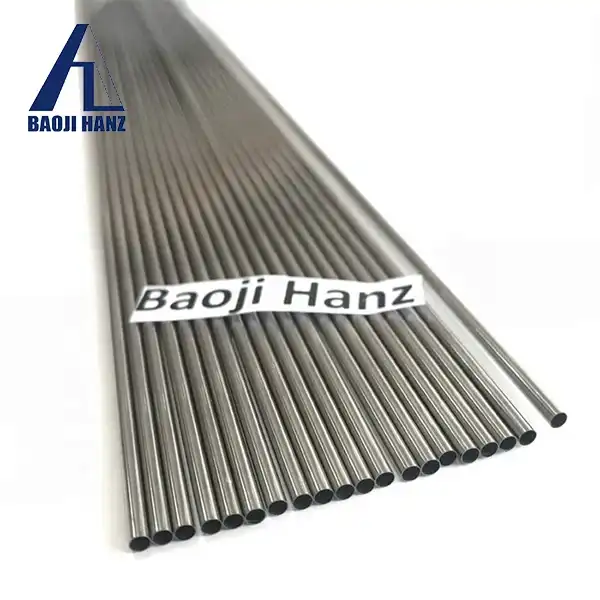
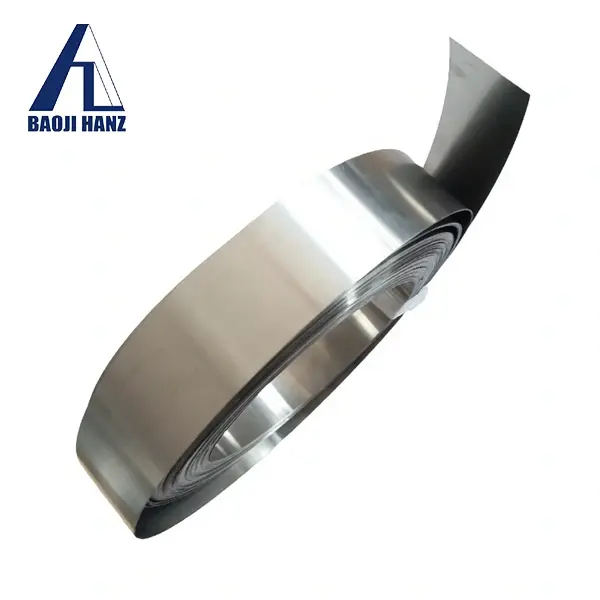
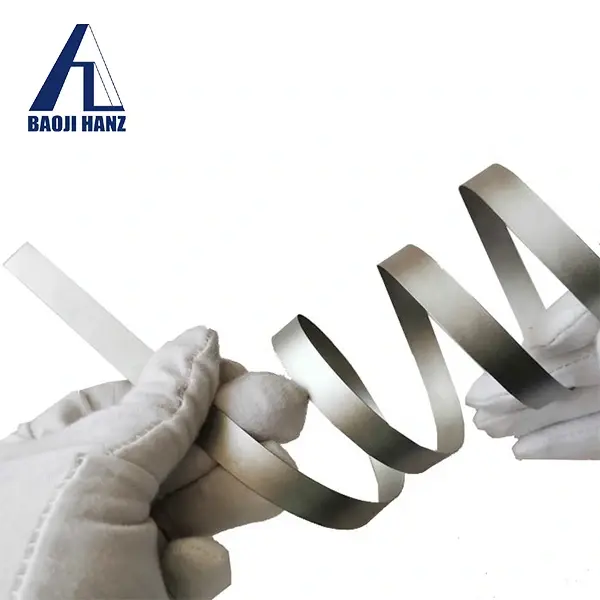
ASTM F2063 Shape Memory Nitinol Strip


Content:Ti (Min)45%, Ni:55.4%--56.2%
Standard:ASTM F2063/ Q/XB1516/Q/XB1520
Processing Service:Cutting
Density: Approximately 6.45g/cm³
Feature:Super elastic, shape memory, high strength
Surface:black, polished, oxidized
MOQ:1kg
Size:Customized
Application environment: Industry, medical care
ASTM F2063 Shape Memory Nitinol Strip - Precision Foil for Medical and Industrial Use
Baoji Hanz Metal Material Co., Ltd. makes the ASTM F2063 Shape Memory Nitinol Strip. Vacuum melting gets the process going. Next comes flat rolling on a cold roller. Ti (min 45%) and Ni (54.5–57.0 wt%) are what the strip is built from. Density lands close to 6.45 g/cm³. Thickness runs from 0.03 to 1 mm. Dimension tolerances hold as tight as ±0.003–±0.02 mm. From -20°C to 100°C, the Af transformation temperature can be set. Over that range, your actuation needs can be met by the strip.
Technical Specifications
|
|
|
| Element | Composition (%) |
|---|---|
| Nickel (Ni) | 55.8 - 57.0 |
| Other name | niti strip |
| Titanium (Ti) | Balance |
| Iron (Fe) | <0.05 |
| Oxygen (O) | <0.02 |
| Carbon (C) | <0.05 |
| Nitrogen (N) | <0.02 |
Why Nitinol Strip Fits Demanding Applications
Common spring metals often can't keep up when a part is loaded over and over. The part still has to hold its size. It also has to spring back and resist corrosion at the same time. This strip fills that need. It relies on the natural traits of the Ni-Ti alloy system.
How it is processed sets the tensile strength. Values fall in the 550–1,900 MPa range. Elongation can reach 10–20%. Repeated deformation is where that 10–20% elongation helps. The ultra-thin rolled format still keeps shape memory effect and superelasticity, even at 0.03 mm. Micro-scale actuator and implant designs depend on this. At that size, material thickness drives device geometry directly.
The Ni-Ti blend itself provides the corrosion resistance. That same blend works well in the body. The strip often holds up where it meets body fluids. Harsh plant conditions show up just as often. Many of those jobs need no extra surface coating at all.
Key Features
Superelasticity and Shape Memory Effect
After it is deformed, the strip goes back to the shape it was programmed to take. Repeated load cycles do not wear that behavior out. Spring elements can use it for that reason. So can actuators, and so can implantable components, wherever the part has to recover its shape in one direction or in two.
Ultra-Thin Precision Rolling
At its thinnest, the strip measures 0.03 mm. Tolerance holds at ±0.003 mm even there. Stacked layers of medical parts rely on this. Micro-fabricated components rely on it too. The reason is simple: stack tolerances pile up.
Af Transformation Temperature Is Customizable
Heat treatment sets the Af temperature. It can land anywhere from -20°C to 100°C. A fixed trigger point is often required in thermally actuated assemblies. The strip can be made to hit that point.
Surface Conditions Available for ASTM F2063 Shape Memory Nitinol Strip
You can get the surface pickled, bright polished, or ground. The finish you choose shapes the steps that come later. It also sets the cleanliness level medical work needs. At the surface layer, sizes hold steady as well.
Stampable and Laser-Cuttable
This strip suits stamping. Laser cutting works on it too. Precision part makers use both routes, whether the end product is a medical device or an industrial micro-assembly.
Applications of ASTM F2063 Shape Memory Nitinol Strip
Medical Devices
Foils for interventional devices start with this strip. Micro-implant accessories come from it too. Springs inside minimally invasive instruments are another use. Two properties matter here. One is biocompatibility. The other is shape recovery. Take catheter parts. A material for them has to bend and spring back. Endovascular tools need the same. So do orthodontic elements. No permanent set should remain.
The Af temperature is adjustable. The format is ultra-thin as well. Combine both features, and a designer can control how the material acts at the temperatures a device will meet in use. That matters a lot for implantable parts. They must activate at body temperature.
Industrial Applications
Microswitches and sensor springs are where industrial buyers put this strip. Thermal-actuated parts use it too. Across thermal cycles, shape recovery must stay steady. On those parts, that point matters most. Tensile strength falls between 550 and 1,900 MPa. Elasticity is what some jobs need. For other jobs, the strip has to carry structural load. That range covers both cases.
Flexible electronics and micro-device assemblies need a strip that springs back and resists corrosion. With both traits, service life gets longer. In the same spot, ordinary spring steel would corrode sooner. Fatigue would also cut it short.
Manufacturing and Quality Approach
Vacuum melting is the first step. Cold rolling comes next. Final heat treatment is the last one. All of it happens under one roof. With that setup, chemical composition stays consistent. Phase transformation behavior also stays the same from batch to batch.
Material is made to GB 24627-2009 and ASTM F2063-18. Those standards set the limits for chemical composition. They also cover mechanical property ranges and phase transformation performance. Every batch goes through a chemical composition analysis. Mechanical properties get tested too, and a DSC measurement gives the phase transformation temperature. Test documentation can be provided on request. Incoming inspection and regulatory review both rely on it.
Medical-grade and industrial-grade material both come off our line. The MOQ is 1 kg. Lead time is 15–30 working days. For the ASTM F2063 Shape Memory Nitinol Strip, you can request custom specs on thickness, Af temperature, surface finish, and packaging.
| Thickness (mm) | Width (mm) | Length (m) | Transformation Temperature (°C) |
|---|---|---|---|
| 0.1 - 2.0 | 1 - 30 | Customized | 22 - 100 |
FAQ
Q: Which standards does your nitinol strip meet?
A: GB 24627-2009 and ASTM F2063-18 govern production. Those specs fix the chemical composition and the mechanical properties. Phase transformation requirements also come from them. Medical grades follow the same specs. Industrial grades do too.
Q: Can the Af transformation temperature be customized?
A: Yes. Heat treatment keeps Af temperature under control. Coverage runs from -20°C to 100°C. Tell us the temperature you need. We hold it as a production parameter.
Q: What is the minimum order quantity?
A: 1 kg is the MOQ. A prototype can be made from that amount. Small development batches work with it too, and so does research.
Q: What surface finishes can you supply?
A: You can get pickled surfaces. Bright polished and ground finishes are also on offer. What you pick comes down to the next step in your process. For medical work, polished surfaces are usually the spec. Those parts need to stay clean and keep a consistent surface dimension.
Q: What keeps one batch the same as the next?
A: We test every batch for chemical composition and mechanical properties. DSC phase transformation temperature gets checked too. Paperwork ships with the order.
Q: Is this strip suitable for medical implant applications?
A: Our this product follows ASTM F2063-18. That standard is the reference point for Ni-Ti shape memory alloys in medical devices. Whether it fits a given implant comes down to your device design and what the regulators require.
Contact Us
Technical questions or specifications can go to baojihanz-niti@hanztech.cn. Need material data sheets for ASTM F2063 Shape Memory Nitinol Strip? Just ask. DSC test reports are available too.
YOU MAY LIKE

.webp "Astm F2063 Superelastic Nitinol Straight Wire")