.webp)

.webp)
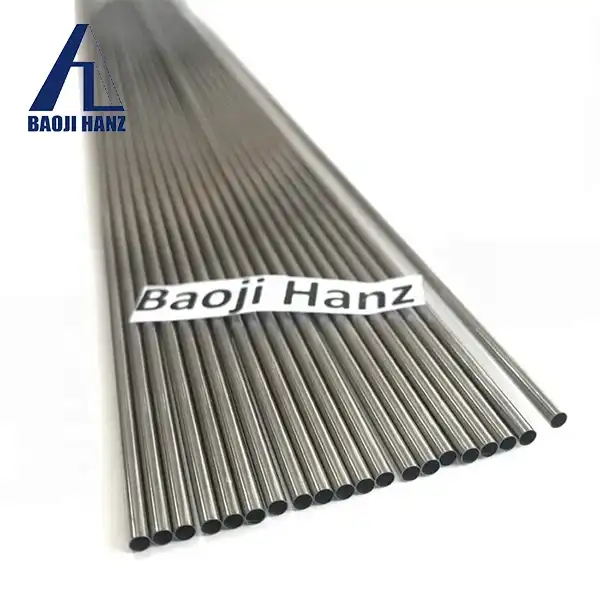
Nitinol Alloy Tube


Nickel content:Above 50.4%
Ti (Min):44%
Size:Customized
Strength:850
Surface:Polished surface
Standard:ASTM F2063,GB 24627
Density:6.5g/cm3
Technique:Cold Rolled
MOQ:10pcs
Application:Medical care and industry
Nitinol Alloy Tube for Medical & Industrial Use
Precision Nitinol Alloy Tube from Baoji Hanz Metal Material Co., Ltd. is built to ASTM F2633-19 and GB 24627. NiTi alloy is the starting material. Nickel content runs 54.5–57.0 wt%. The balance is titanium. Density measures 6.45 g/cm³. Tensile strength holds at ≥ 1000 MPa. Outer diameters span 0.25 to 7.0 mm. Walls can be as thin as 0.02 mm. Medical-grade and industrial-grade needs both get covered. Buy one prototype or a full production run.
Why Standard Metal Tubes Fall Short
Ordinary metal tube often gives out when it is bent again and again. High-stress cycling wears it down too. Temperature-driven actuation is one more case where it fails. Kinking turns up. So does fatigue fracture. And once the tube is deformed, it will not come back to its shape. Engineers building minimally invasive medical devices hit this all the time. So do the ones working on precision industrial assemblies.
Nitinol tube handles these problems. Two things do the work: superelastic flexibility and shape memory you can program, both inside a hollow lumen with no seam. The tube fights off kinks as it is steered into place. Large deformation gets reversed. Set it to actuate at a chosen temperature and it will. Stainless steel and standard titanium tube give you none of this.
Key Advantages
Superelasticity and Shape Memory
The tubes show superelastic recovery. Phase transformation between martensite and austenite drives a shape memory effect as well. A significant amount of bending deformation gets taken up, and the tube comes back to its original shape reliably. Catheter systems are one place this counts. Stent delivery and sensor-based assemblies are other fits.
High Dimensional Accuracy
Tolerance on the OD is held to ±0.02–±0.05 mm. Wall thickness holds to ±0.01–±0.03 mm. Cold rolling leaves a seamless structure with even wall thickness and good coaxiality. Some applications need fluid integrity and steady dimensions, and this structure supports them.
Fatigue and Corrosion Resistance
Long-cycle work is what these tubes are built for. Fatigue resistance holds up, and corrosion performance carries them into body fluid environments. Harsh industrial conditions suit them too. Where direct patient contact is required, medical-grade material is available.
Customizable Transformation Temperature
Af transformation temperature can be set anywhere from -20°C to 100°C. With that range, thermal-actuated deformation gets tuned to one specific application. Smart actuator systems are one fit. Pipe coupling joints are another. Memory alloy ring assemblies use the same approach.
Secondary Processing Support
Downstream precision work is supported too. Cutting, flaring, necking and slotting all fall in that group. Engineering teams get the room they need to turn the material into finished components.
Technical Specifications
| Parameter | Value |
|---|---|
| Material | NiTi Alloy (Nitinol) |
| Standard | ASTM F2633-19, GB 24627 |
| Ni Content | 54.5–57.0 wt% |
| Ti Content | Balance (Min 44%) |
| Density | 6.45 g/cm³ |
| OD Range | 0.25–7.0 mm |
| Wall Thickness | 0.02–3.0 mm |
| Length | 500–2000 mm (customizable) |
| OD Tolerance | ±0.02–±0.05 mm |
| Wall Thickness Tolerance | ±0.01–±0.03 mm |
| Af Temperature | -20°C to 100°C (customizable) |
| Tensile Strength | ≥ 1000 MPa |
| Elongation | ≥ 10% |
| Platform Stress (3% strain) | ≥ 380 MPa |
| Delivery Condition | Cold-worked, shape-set annealed |
| Outer Surface | Oxidized state / ground state |
| Inner Surface | Clean state / oxidized state |
| MOQ | 10 pcs |
| Lead Time | 25–35 working days |
| Chemical element | Af range | Available production Line | Usage | Sample |
| Nickel 55% Titanium 45% | 0℃to 100℃ | Rod&wire,Plate&sheet,Strip&foil | Medical&Industry | On stock (various specification) |
| Nickel 55% +V +Ti | ||||
| Nickel 55% +Fe +Ti | Subzero 30℃ to -5 ℃ | Rod&wire,Plate&sheet | Industry | On stock |
| Nickel 55%+Cr +Ti | (limitedspecification) | |||
| Nickel 55% +Hf +Ti | Above 100C | Ingot | Ingot | updating |
Application Scenarios for Nitinol Alloy Tube
Medical Devices
Minimally invasive devices need flexibility and biocompatibility. Nitinol Alloy Tube delivers both. Vascular catheters are a common use. Injection needles, dental instruments, stent frames and bone cement delivery devices use it too. Surgical tool tube components depend on it as well. Each tube is made in one piece. Catheters and delivery systems move through complex anatomy without kinking, thanks to its superelastic behavior. Procedures stay reliable.
Industrial Applications
On plant floors, Nitinol tubes show up as sensor fastener components. Pipe coupling joints are another job they handle. They also work as memory alloy rings that react to temperature change. Heat one to a set point and it returns to the shape it was trained to hold. That behavior suits smart assembly and actuation systems. Ordinary metals in those same spots would need outside mechanical actuation to move.


Manufacturing and Quality
Baoji Hanz makes Nitinol Alloy Tube itself, with no outside steps. Vacuum melting comes first, and cold rolling follows. Final heat treatment closes the route. Keeping all of it under one roof means the chemical composition holds steady, and phase-transformation performance stays stable from batch to batch. ASTM F2633-19 and GB 24627 apply at every stage.
Every batch we ship goes through testing. We check chemical composition, mechanical properties, and DSC phase-transformation temperature. Full test reports are yours on request. They can go straight into your qualification or procurement paperwork.
You pick the OD. Wall thickness, length, Af temperature, surface finish, and packaging can all be set to your spec. Raw tube stock is available, and so are further-processed parts. Orders start at 10 pcs. That MOQ works for R&D programs. It fits pilot production too, and volume orders.

FAQ
Q: Which standards does your this product meet?
A: The tubes comply with ASTM F2633-19 and GB 24627. Chemical composition, mechanical properties, and DSC phase-transformation temperature are tested per batch, with test reports provided on request.
Q: Can the Af transformation temperature be customized?
A: Yes. Af temperature can be set anywhere from -20°C to 100°C. Tell us the transformation range you need when you place an order. Choose one that matches the thermal conditions your application runs in.
Q: What sizes are available? What if my part does not fit the standard dimensions?
A: Standard OD spans 0.25 to 7.0 mm. Wall thickness runs 0.02 to 3.0 mm. Length can go up to 2000 mm. Parts outside those figures? Send us your technical requirements and we will go through them with you.
Q: Is this tube suitable for medical devices?
A: We carry medical-grade material. Catheters, stents, and dental instruments are common places it ends up. So are other parts that touch patients. Send your application details our way. We will confirm the grade and specification that fit your job.
Q: How low can the order quantity go, and how long does delivery take?
A: We ask for 10 pcs as a minimum. Give us 25–35 working days for a standard order.
Q: Can you also do secondary work like cutting or flaring?
A: Yes. The tubes can go through secondary steps. We cut, flare, neck, and slot them. That work is accurate. You get parts that sit closer to the final spec you need.
Contact Us
Send a drawing or a specification for a Nitinol Alloy Tube to baojihanz-niti@hanztech.cn. You can also send a technical question. We will reply with a quote. Need an application recommendation?
YOU MAY LIKE

.webp "ASTM F2063 Superelastic Nitinol Capillary Tube")

.webp "Nitinol spring")


.webp "Nitinol SMA Tube")