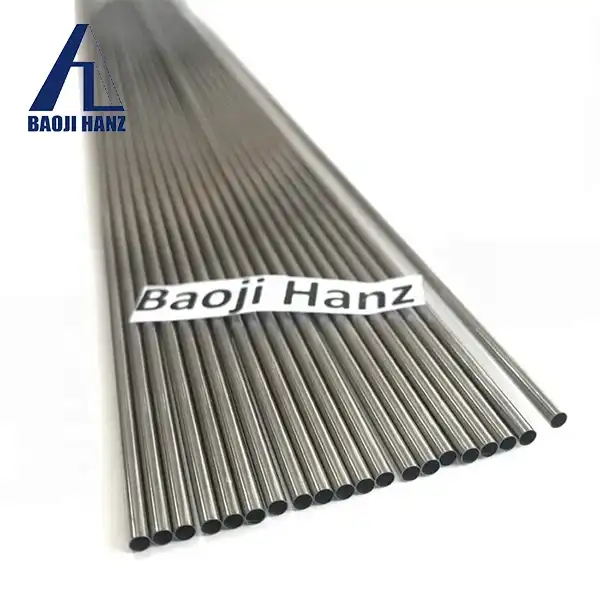
Nitinol Wire Ropes


Material:nickel titanium alloy or Ti-Ni Alloy
AF:-20℃~10℃
Surface:mechanical polishing
Density:6.45g/cm3
Specification (MM):1*7mm
Wire size:0.3mm
MOQ:5meters
Application: Industry
Nitinol Wire Ropes for Medical & Industrial Use - Superelastic Braided Solutions
Nitinol Wire Ropes come from Baoji Hanz Metal Material Co., Ltd. A 1×7 strand structure is used in every rope. Wire on a single strand measures 0.05–0.5 mm. Across the whole rope the span reaches 0.15–1.2 mm. Af runs from −10°C to +20°C. The alloy is Ni 54.5–57.0 wt% Ti-Ni. GB 24627-2009 and ASTM F2063-18 are both met. One property is shape memory. Another one is superelasticity. Braided flexibility arrives with both. Medical devices put the rope to use. Industrial engineering has its own reasons for choosing it.
How ropes Differs from Standard Steel Wire Rope
Steel wire rope of the standard kind stays stiff. Rust takes hold of it fast. Shape memory is missing. Superelastic recovery is absent too. One job might ask for repeated bending cycles. On another, actuation driven by heat could be needed. A third may want biocompatible performance from the material. None of those cases is covered by conventional wire rope. There it is not a viable option.
Several strands are braided together to make this product, and the flexibility that comes out of it is something solid nitinol wire cannot match. Bend the rope through a wide angle. Back it comes to its original shape. Nothing permanent stays behind. Superelasticity is what delivers that result. Thermal-driven actuation comes out of the shape memory effect. No conventional metal rope manages either one. A long list of demanding engineering environments therefore suits this rope.

Technical Specifications
| Parameter | Details |
|---|---|
| Product Name | Nitinol Wire Ropes |
| Material | Nickel Titanium Alloy (Ti-Ni Alloy) |
| Standards | GB 24627-2009 / ASTM F2063-18 |
| Chemical Composition | Ni 54.5–57.0 wt%, Ti balance |
| Density | 6.45 g/cm³ |
| Specification | 1×7 strand structure |
| Single Wire Diameter | 0.05–0.5 mm |
| Rope Diameter | 0.15–1.2 mm (customizable strand count) |
| Dimension Tolerance | ±0.03–±0.10 mm |
| Af Temperature | −10°C to +20°C (customizable) |
| Tensile Strength | > 1000 MPa |
| Elongation | > 10% |
| Platform Stress | > 350 MPa |
| Surface Condition | Black oxide / light oxide (golden yellow to brown) |
| Delivery Condition | Shape-set annealed / cold-worked |
| MOQ | 200 m (stock) / 500 m (customized) |
| Lead Time | 25–35 working days |
Key Characteristics
Braiding several strands together makes the rope. Loads that repeat in cycles hit this build, and it stands up to fracture, fatigue, and torsion. Strands stay together in normal use. Straighten the rope and the structure is still whole.
The Ti-Ni alloy itself carries the corrosion resistance. That property comes from the composition. A coating does not give it. Medical-grade versions pass ASTM F2063-18. Device makers often cite this standard when they qualify a material. Af transformation temperature can be tuned inside a set range. Thermal-contraction tension work is another place where the rope fits.
After delivery, cutting is supported. So is end-welding. Downstream assembly gets simpler for engineering teams. That helps a lot when device geometries are complex.

Application Scenarios
Medical Applications
Catheter and endoscope systems use these ropes as traction lines. Device engineers fit them in there. Implant locking ropes are another job they handle. Pulling parts for minimally invasive procedures count too. Bending comes easy to these ropes. ASTM F2063-18 is met. Where mechanical performance and material qualification both count, that pairing holds up.
Industrial Applications
Industry uses them as pulling ropes, Nitinol Wire Ropes, that remember their shape. They also serve as flexible parts that carry motion, and as tension ropes that shorten once heated. Damping ropes built for particular jobs are a third use. Rope made of nitinol fits work that bends and unbends again and again. Corrosive conditions are no problem. Neither is a setup where heat does the moving.
Nitinol Wire Ropes Manufacturing and Quality Control
Chemistry work stays in-house. Melting and heat treatment stay there too. That setup lets us steer phase transformation directly, batch after batch. GB 24627-2009 and ASTM F2063-18 are met by every product.
Every batch gets checked. We test the chemistry, the mechanical properties and the DSC phase-transformation temperature. Reports from those tests can be sent on request.
Rope diameter, Af transformation temperature, surface finish, strand count, and packaging format are all customizable. Finished formed parts are also available where required.
Frequently Asked Questions
Q: What is the minimum order quantity?
A: Standard sizes from our stock carry a 200 meter MOQ. Custom specs need 500 meters. Lead time on those runs 25–35 working days.
Q: Can the Af transformation temperature be adjusted?
A: Yes. Our standard range goes from −10°C to +20°C. That can be changed to suit your thermal actuation or deployment needs. Put your application conditions in the inquiry and we will pick the right spec with you.
Q: What surface finishes are available?
A: Two surface conditions are on offer: black oxide and light oxide (golden yellow to brown). Which one you take depends on downstream processing. Corrosion and visual needs play a part too.
Q: Can this product be used in medical device applications?
A: Yes, we can supply Medical-grade this product. It meets ASTM F2063-18. People often ask for this standard when they qualify materials for medical devices.
Q: What happens to the rope once a mechanical load pulls on it?
A: Tensile strength comes in above 1000 MPa. Elongation is over 10%. Platform stress clears 350 MPa. When loading repeats, the braided structure helps the rope stand up to fatigue and torsion.
Contact Us
Want specs, samples, or a custom project? Email baojihanz-niti@hanztech.cn. How will you use the Nitinol Wire Ropes part? Tell us. Our reply will then match your case.
YOU MAY LIKE

_1740042005804.webp "Nickel titanium coil springs")
.webp "Astm F2063 Super Elastic Nitinol Flat Wire")
.webp "Astm F2063 Superelastic Nitinol Straight Wire")