_1794475594850.webp)
_1794475594856.webp)
_1794475594877.webp)
_1794475594880.webp)
_1794475594901.webp)
_1794475594902.webp)
medical nitinol wire


Medical Nitinol Wire for Interventional & Surgical Applications
Medical nitinol wire is made by Baoji Hanz Metal Material Co., Ltd. Production follows ASTM F2063-18 and GB 24627-2009. The alloy holds 54.5–57.0 wt% nickel. Titanium fills the rest. Sizes run from Φ0.025 to 4 mm. Tolerances hold as tight as ±0.002 mm. Tensile strength hits ≥1300 MPa. AF temperature can be set anywhere between −10°C and 80°C. Guide wires come from this wire. Vascular stents do too, and so do orthodontic arch wires. Thermally actuated components use it as well.
Key Characteristics
Bend an ordinary metal wire enough times. The bend stays put. Springback force also drops off over time. Nitinol works another way. The cause is its austenite-martensite phase transformation. That mechanism is why the wire returns the same elastic recovery each time. Heavy deformation does not change it either.
Superelastic recovery: Squeeze the wire or bend it hard. It still comes back to the shape it was set to. Devices for minimally invasive work rely on that trait. They must travel through anatomy that curves or narrows.
Dimensional precision: Diameter tolerance holds between ±0.002 and ±0.02 mm over the whole Φ0.025–4 mm range. Catheter assemblies rely on that level of repeatability. Spring coils need it too, and so do woven mesh structures.
Fatigue behavior: Repeated flex cycles are no problem for Nitinol. That trait helps implantable devices. Parts made for long-term use gain from it too. Check fatigue data for your own case anyway. Compare it with your test protocol.
Customizable transformation temperature: AF temperature can be set anywhere from −10°C to 80°C. For medical use, AF 25°C–40°C is the standard range. Body-temperature activation comes from that range. Other ranges work for thermal actuation in industrial settings.
Processing compatibility: Bending is no problem. Nor is spring coiling or mesh weaving. The wire holds its structure through downstream fabrication.

Technical Specifications
| Performance Parameter | Value Range |
| Density | 6.5g/cc |
| Tensile Strength | 800~1100 MPa |
| Yield Strength (Austenitic State) | 150~300 MPa |
| Elongation | 20%~40% |
| Elastic Modulus (Austenitic State) | 70~80 GPa |
| Hardness (HV) | 250~350 |
| Field | Type | Diameter Range | AF Temperature | Core Shape Memory Function |
| Cardio - cerebrovascular Department | Vascular Stent Wire | 0.15~0.5 mm | 32~37℃ | Compressed to small diameter in vitro, and restored to tubular supporting shape at human body temperature in vivo |
| Stomatology | Orthodontic Archwire | 0.2~0.55 mm | 28~35℃ | Bent into tooth - aligned shape at low temperature, restored to ideal dental arch curvature at oral temperature, and exerted continuous force for orthodontics |
| Urology Department | Stone Retrieval Basket Wire | 0.2~0.8 mm | 30~36℃ | Compressed into linear shape in vitro, restored to net shape in vivo to wrap stones |
| Gynecology Department | Shape Memory IUD Stent Wire | 0.3~0.6 mm | 33~37℃ | Deformed into compact state at low temperature during implantation, and restored to supporting shape in vivo to fit uterine cavity |
| Minimally Invasive Surgery | Instrument Elastic Component Wire | 0.4~1.0 mm | 25~35℃ | Folded and deformed in vitro to pass through minimally invasive incision, and restored to working shape in vivo |
Material Processing & Quality Control
Every production batch of medical nitinol wire begins with vacuum melting. A consistent chemical composition gets locked in at that stage. Impurities that could drag down mechanical performance are cleared out too.
Baoji Hanz tests each batch one by one. Chemical composition gets checked, so do mechanical properties and DSC phase-transformation temperature. Every batch ships with a test report. Ask and you can have it. These reports help with incoming inspection and regulatory documentation.
Vacuum melting comes first. Cold drawing follows. Final heat treatment is the last step. Every stage runs in our own plant. That gives direct control over the variables that affect phase-transformation behavior and dimensional consistency. No work is handed to outside processors.
Application Scenarios
Guide wires get an edge from superelasticity and kink resistance. That pays off when they steer through blood vessels. Bring the material up to body temperature, or close to it, and it returns to a shape set earlier. Stents placed in vessels depend on this. So does suture thread. Dental root canal files work the same way. Orthodontic arch wires do too.
These properties matter outside medical devices as well. Eyeglass frames, woven stents, and mobile phone antennas use them too. Every one of those designs has to take repeated deformation and resist corrosion. Good spring recovery in a small package counts as well.
Supply capabilities for medical nitinol wire
- Compliance with both standards: Each product meets ASTM F2063-18 and GB 24627-2009. That covers chemical composition. Mechanical properties and transformation temperature fall under it too.
- Customization options: You can specify the diameter, the AF transformation temperature, and the surface finish. Packaging format and transportation method are yours to choose as well. We supply raw wire and shape-set formed parts too.
- Documentation support: Each order ships with batch test reports. Chemistry, mechanical properties, and DSC results are all included in them.
- Low entry quantity: You can start small. Standard wire has a 2 kg MOQ, and fine filaments have a 200 meters MOQ. That covers both development work and full production buying.
- Lead time: Standard orders usually take 20–30 working days. Tight schedule? Talk to the team before you place the order.
Packaging & Shipping
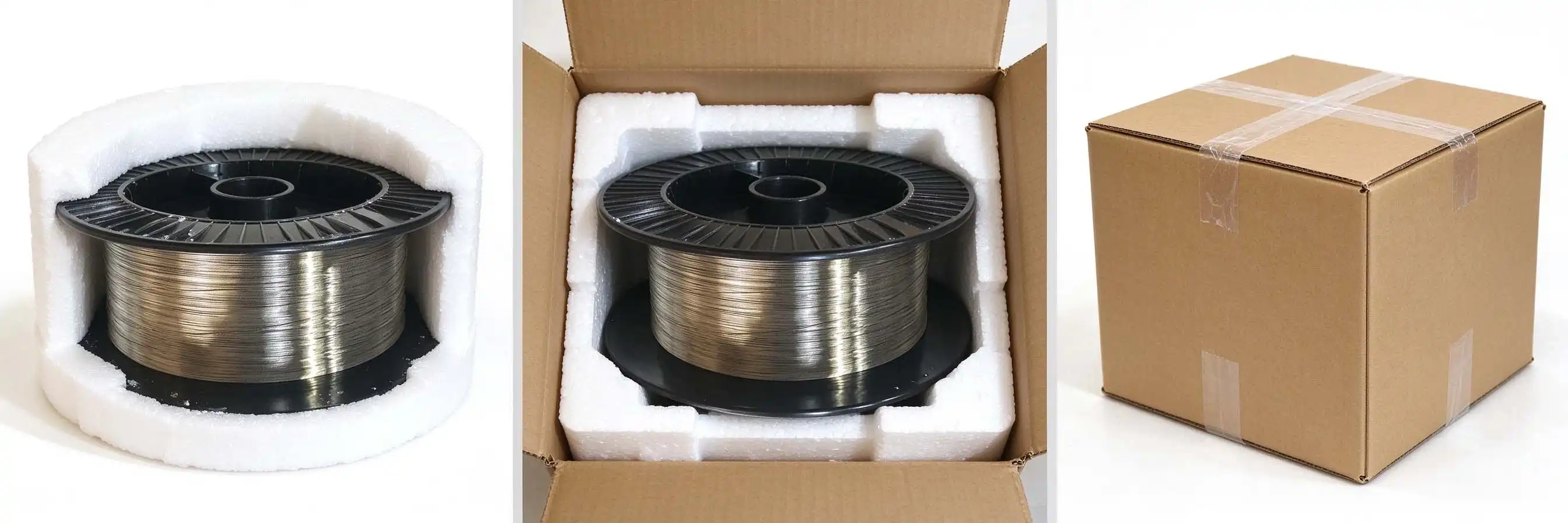
Wire goes out as coil or as straight lengths. Shock and moisture protection covers every pack. Coils also get a moisture-proof paper wrap, which keeps the surface in good shape in transit. How we ship medical nitinol wire depends on the destination and on how fast you need it.

FAQ
Q: Which standards do your this product meet?
A: All products meet ASTM F2063-18 and GB 24627-2009. Chemical composition is covered by those standards. Mechanical properties are covered too. So is the phase-transformation temperature.
Q: What AF temperatures are available?
A: AF temperature runs from −10°C to 80°C, and you can pick the range. For parts that activate at body temperature, the standard medical range (AF 25°C–40°C) fits. Other ranges are for thermal actuation needs.
Q: Do you offer custom diameters and surface finishes?
A: We do. You can pick any diameter between Φ0.025 and 4 mm. For surface condition, there are three options: pickled, bright polished, or ground. Which one you get depends on what happens to the wire further down the line.
Q: Do you provide test reports?
A: Yes. Batch test reports covering chemical composition, mechanical properties, and DSC phase-transformation temperature are available upon request for every order.
Q: What is the lead time?
A: Standard lead time is 20–30 working days. This may vary depending on specification, quantity, and current scheduling - contact us to confirm before placing an order.
Contact Us
Send your specifications or project requirements for medical nitinol wire to baojihanz-06@hanztech.cn. We provide technical support from initial inquiry through delivery.
_1753930177984.webp "nitinol ingot")
_1751266472736.webp "nitinol bar")


_1750148477057.webp "Superelastic Nitinol Wire with room temperature")