_1751420411641.webp)
_1751420411628.webp)

_1751420411652.webp)
_1751420411654.webp)
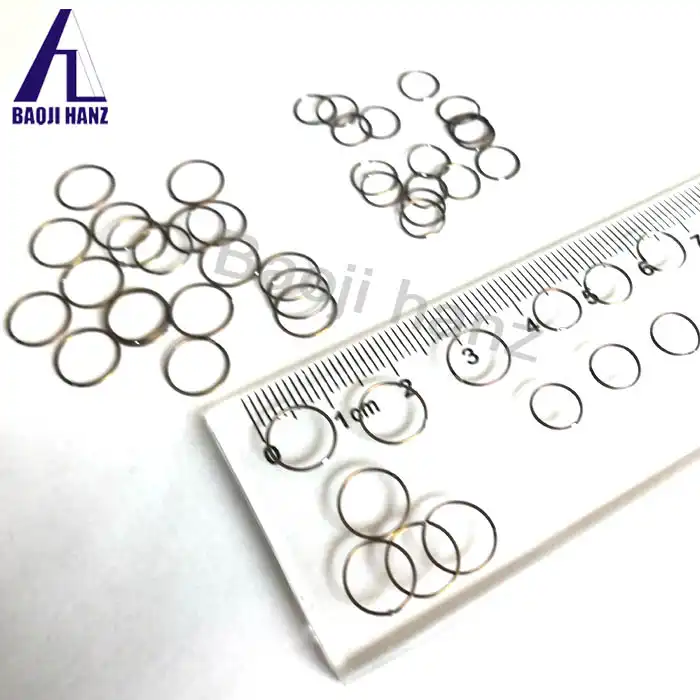
nitinol ring


Feature: superelastic and shape memory
Surface: oxided, polished, black
MOQ 100 pieces
Material: nickel titanium alloy
Chemical: Ni54.5~57%, Ti balance
Original: Shaanxi, China
Standard : ASTM F2063
Af range: -10 C ~ 100C
Application: medical, non medical and other
Keywords: niti, nitinol, TiNi, nickel - titanium alloys, titanium - nickel alloys,
Quote need to know: ring diameter, ring thickness, quantity
Nitinol Ring for Medical & Industrial Locking Applications - Precision Shape Memory Components
Baoji Hanz Metal Material Co., Ltd. makes these precision nitinol ring. Nickel-titanium is the base alloy. Of the total, nickel accounts for 54.5 to 57.0 wt%. Titanium covers the rest. Production follows GB 24627-2009. ASTM F2063-18 applies as well. Af points sit anywhere between minus 10°C and 100°C. Shape memory and superelastic behavior still hold over that whole span. Inner diameters run 2 to 200 mm. Wall thickness ranges from 0.2 to 10 mm. Heights of 1 to 50 mm are available. Tolerances reach ±0.03 mm at their tightest. Surface finish comes oxidized, pickled, ground, or polished.
What Is Ring and How Does It Work?
Precision parts like these get cut from nickel-titanium shape memory alloy. Cool the ring below its transformation temperature. It opens wide enough to seat. Once it passes the Af point, the part shrinks back to the shape it remembers. Body warmth alone can set it off. Room temperature works too. A controlled heat source does the same. Clamping force then builds by itself and holds steady.
Ordinary metal snap rings behave differently. Over time their clamping force can fade. Change the temperature and they have no way to answer back. On the nitinol part, heat does the locking on its own. Mechanical fasteners are not needed. Nor are adhesives. Assembly gets simpler in tight spaces or sterile rooms.

Technical Specifications
| Product name | NiTi rings |
| Material | nickel titanium alloy |
| Chemical | Ni54.5~57%, Ti balance |
| Standard | ASTM F2063 |
| Af range | -10 C ~ 100C |
| Keywords | niti, nitinol, TiNi, nickel - titanium alloys, titanium - nickel alloys, |
| MOQ | 100 pieces |
| Application | medical, non medical and other |
|
Advantage of nitinol ring 1. Good biocompatibility ,it will not cause significant rejection reactions; |
|
|
|
Features 1. SME, shape memory alloy nickel titanium, Nickel titanium alloy rings can be shaped into temporary shapes at low temperatures (such as saline water), and when the temperature rises to human body temperature (about 37 ℃), they will automatically return to their original preset shape. 2. Superelastic, Under external force, nickel titanium rings can undergo elastic deformation far exceeding that of ordinary metals (strain can reach 8% -10%), and quickly recover to their original state after unloading, with stress not increasing linearly with strain. 3. Biocompatibility and Corrosion Resistance, A dense titanium dioxide (TiO ₂) oxide layer is formed on the surface of nickel titanium alloy, effectively inhibiting the release of nickel ions and reducing cell toxicity. |
|
Application 1. Orthopedic internal fixation: Nickel titanium clasps (such as clavicle fracture clasps) provide sustained gripping force through shape memory effect, without the need for screws or steel plates. Only the outer membrane of the bone needs to be peeled off to fix the fracture end, reducing damage to the blood supply of the inner membrane and accelerating healing. Its low elastic modulus can disperse stress and reduce the risk of secondary fractures 2. Orthodontic treatment: Nickel titanium archwire utilizes its superelastic properties to continuously apply gentle orthodontic force at oral temperature, gradually moving teeth and reducing patient discomfort. Its shape memory effect can automatically restore the shape of the archwire, avoiding deformation due to bite pressure 3. Vascular stent: Self expanding nickel titanium stent is compressed and delivered to the lesion site at low temperature, and after release, it returns to its original state with body temperature to support narrow blood vessels. Its super elasticity can adapt to vascular bending, reduce the risk of restenosis, and is widely used in coronary artery and peripheral vascular diseases |
|


Key Characteristics
Controlled shape memory activation. Heat the ring past the Af point and it goes back to its locking geometry. That gives you thermal actuation on its own. No extra mechanical parts are needed.
Tight dimensional tolerances. With tolerances as tight as ±0.03 mm, the ring delivers consistent opening and closing performance across production batches - relevant for both medical-grade and precision industrial use.
Fatigue and corrosion resistance. Heat Nitinol and cool it again, cycle after cycle, and it keeps holding up. The drop in performance stays small. Parts built to ASTM F2063-18 match the chemical makeup and mechanical property specs that medical device work calls for.
Multiple surface finish options. You can order the parts oxidized. Pickled works too, and so do ground and polished surfaces. Where the part ends up decides which one you take. How clean the surface has to be plays a part as well. So does the look you're after.

Application Scenarios
Medical applications include orthopedic memory fixation rings that use body temperature to activate the clamping effect, as well as locking rings and clamping rings for interventional instruments. These applications rely on the dimensional consistency and ASTM F2063-18 compliance of the material.
Industrial applications take in a few different part types. Thermally actuated locking rings are one of them. Another is the pipe clamp that has to tighten once temperature sets it off. Sensor elastic rings belong in this group too. Then you have snap rings, which turn up in mechanical assemblies where the actuation should happen on its own as heat rises.
Af temperature can be set anywhere from −10°C to 100°C. That range lets you line the activation threshold up with the temperature your process runs at. Need body-temperature activation? Set it to 37°C. Industrial process environments may call for higher setpoints.
Customization Options for nitinol ring
Rings can be ordered using these parameters:
- We build to the inner diameter, the wall thickness, and the height shown on the drawings you send us
- The Af transformation temperature gets set so it lines up with the activation conditions you are aiming for
- Surface finish switched from oxidized over to polished
- Your logistics needs get covered because we choose the packaging and shipping method
Need a quote? Send us a few details. The inner diameter, the wall thickness, and the height. Tell us the Af temperature you need, plus the surface finish and how many pieces you want. Our engineers review your nitinol ring specs and come back to you. You get feasibility and price. We also tell you the lead time we can meet.
Why Work With Baoji Hanz
All work stays in our own plant. We handle vacuum melting right through to the final heat treatment. No step is outsourced. That keeps the chemical composition steady. Phase-transformation performance stays consistent as well, following GB 24627-2009 and ASTM F2063-18.
Testing covers every batch. A chemical composition check runs on each production batch. Mechanical properties are tested too, and so is the DSC phase-transformation temperature. If you want the test reports, ask and we will send them.
You can get medical-grade and industrial-grade parts from one supplier. Parts for both grades run through the same build steps. Inspection follows the same path too. If you buy for both fields, supplier qualification gets easier.
Customization across geometry, Af temperature, and surface finish. Custom specifications are available for all key parameters, covering both raw material forms and finished formed parts.
Engineers can help with your specs. Our technical team is able to review them. Picking the Af temperature is something they will help you with, and the ring geometry gets checked as well. Clamping needs count as input. So does what your application allows.
FAQ
Q: What info do I need to send to get a quote?
A: Give us the inner diameter and the wall thickness. Height is part of it too. We need the Af temperature you want and the surface finish you have in mind. Add the quantity to the same message. Our team will send pricing and lead time for those specs.
Q: Can the Af transformation temperature be customized?
A: Yes. The Af temperature can be set anywhere from −10°C to 100°C. Body temperature, about 37°C, is where many medical uses switch on. For industrial uses, a higher setpoint may be needed.
Q: Which standards do your this product meet?
A: Each product we ship passes both GB 24627-2009 and ASTM F2063-18. Chemical composition is checked. Mechanical properties are tested as well. So is phase-transformation performance.
Q: Do you provide test reports?
A: Yes. Test reports are available on request for each batch. They cover chemical composition. Mechanical properties are included too. DSC phase-transformation temperature is also included.
Q: What surface finishes are available?
A: Black scale (oxidized) finish is available. Pickled finish is available too. Ground and polished finishes can also be supplied. Your choice depends on the application environment and appearance requirements.
Contact Us
To discuss nitinol ring specifications or request a quote, contact us at hztech05@hanztech.cn. Please include your drawing or key dimensions when reaching out.

_1751266472736.webp "nitinol bar")


_1747884291962.webp "Nitinol tubes")