What Is Nitinol Flat Wire?
Nitinol Flat Wire | Nickel Titanium Alloy Flat Wire
Introduction
Nitinol flat wire, also called nickel titanium flat wire / NiTi ribbon, is a rectangular cross-section shape memory alloy. Compared with traditional round superelastic nitinol flat wire, its flat ribbon geometry brings unique mechanical advantages. It inherits the two core smart-metal characteristics of Nitinol: superelasticity and shape memory effect, widely adopted for medical devices, aerospace actuators, robotics and precision electronic components.
What Is Nitinol Flat Wire?

Nitinol flat wire is cold-rolled and precision drawn from near-equiatomic nickel-titanium alloy. Its cross-section is rectangular. Baoji Hanz Metal Material Co., Ltd. Manufacturers can tune the transformation temperature (Af) and mechanical properties via dedicated heat treatment. Two main grades:
Superelastic Nitinol Flat Wire: Recovers instantly after heavy bending at ambient temperature, no permanent deformation. Most popular for orthodontic archwires and catheter braiding.
Shape Memory Nitinol Flat Wire: Deform at low temperature; regains pre-set shape once heated above Af transformation temperature, used for deployable & thermal actuation structures.
Core Advantages of Flat Profile (vs Round Nitinol Wire)
✅ Larger bonding / welding contact area for assembly
✅ Lower surface stress when bending along thickness direction → longer fatigue life (up to 10⁷ cycles)
✅ Better thermal transfer: higher surface-area-to-volume ratio for fast thermal response
✅ Directional stiffness: rigid on wide side, highly flexible on thin side, ideal for braided catheter reinforcement
✅ Smooth optional edge rounding, removing sharp burrs to avoid scratching tissue or liner
Key Material Properties
Superelasticity: Reversible strain up to 8%, far beyond stainless steel
Shape Memory Effect: Thermally triggered shape recovery
Biocompatibility: Medical grade meets ASTM F2063, suitable for implantable devices
Excellent corrosion resistance: Stable in body fluid, saltwater and weak corrosive environments
High cyclic fatigue resistance, consistent mechanical performance batch to batch
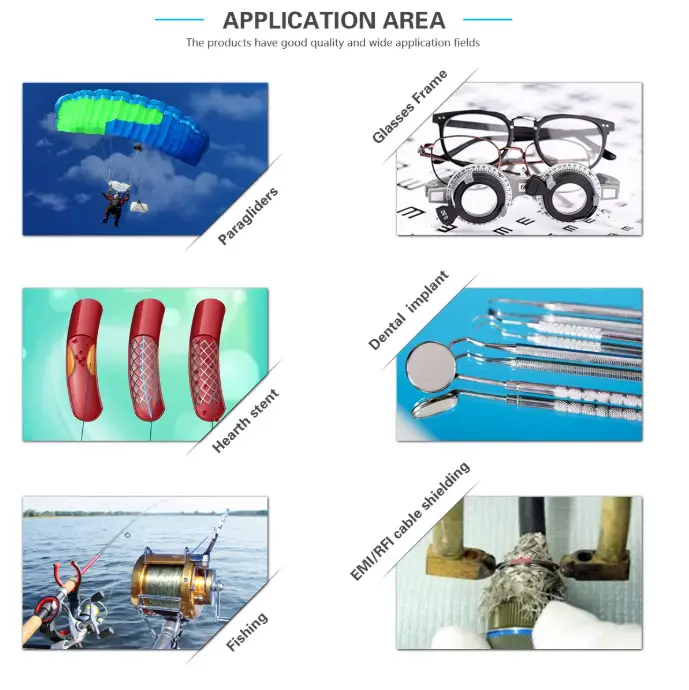
Main Applications
1. Medical Industry (Largest market)
Orthodontic archwires, braided reinforcement layers for minimally invasive catheters, stent components, endoscopic instruments, biopsy tools, surgical staples. Flat nitinol wire allows braided catheter structures to maintain larger inner lumen while keeping small outer diameter.
2. Aerospace & Aviation
Deployable satellite antennas, thermal actuators, vibration damping parts, release mechanisms.
3. Robotics & Precision Automation
Micro grippers, miniature thermal actuators, micro-valve control components.
4. Electronics & Consumer Wearables
Flexible antenna, wearable smart components, flexible spring elements, high-end eyeglass frames.
Custom Specifications & Processing Service
We can customize superelastic nitinol flat wire:
Custom width & thickness, tight dimensional tolerance
Transformation temperature (Af) adjustment
Edge rounding / deburring
Surface options: as-drawn, mechanically polished, electropolished
Slitting, cutting, shape-setting heat treatment
Nitinol Flat Wire VS Nitinol Round Wire
Round wire: uniform bending performance in all directions; simple weaving.
Flat wire: directional flexibility, bigger bonding area, superior fatigue performance for braiding.
Select flat nitinol ribbon if you need catheter braiding, orthodontic archwire or large-area bonding assembly.
FAQ
Q1: What is Nitinol flat wire used for?
A: Mainly orthodontic archwire, catheter braiding, medical stents, aerospace actuators and micro robotic components.
Q2: What standard applies for medical nitinol flat wire?
A: ASTM F2063 is the primary standard for medical grade nickel-titanium alloy.
Q3: Can you provide edge rounding for nitinol flat wire?
A: Yes. Edge rounding removes sharp burrs, critical for medical devices to prevent tissue damage.
Conclusion
The superelastic nitinol flat wire combines the properties of shape memory alloys with the engineering advantages of a rectangular cross-section, enabling it to solve design challenges that circular wire materials cannot handle in high-tech equipment.
Please provide us with the required width, thickness, Af temperature and surface treatment requirements, and we will contact you to provide a quotation.
Send your technical parameters to sales@baojihanz.com, and our engineering team will reply to you within 24 hours.
YOU MAY LIKE