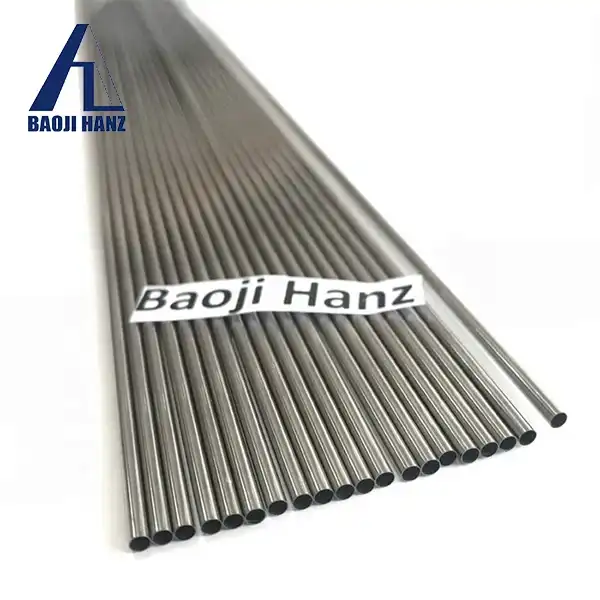
nitinol memory alloy wire


Grade:Niti
Diameter:0.025min
Diameter Tolerance:±0.01mm
Surface:Black Oxidized, Lightly Oxidized, Bright, Ultra Br
Standard:ASTM F2063,GB 24627
Technique:Cold Rolled
Specification:Shape Memory
MOQ:1kg or 500meters
Nitinol Memory Alloy Wire for Medical & Industrial Applications
Nitinol memory alloy wire is supplied by Baoji Hanz Metal Material Co., Ltd. Φ0.025 mm is the smallest size. At the large end, the range goes up to 4 mm. Diameter tolerance stays at ±0.002 mm. Every batch meets ASTM F2063-18 and GB 24627-2009 at the same time. This nickel titanium wire offers both superelastic behavior and shape memory. Medical devices depend on it. So do precision instruments and parts for industrial actuators. Buyers can pick the medical-grade version or the industrial-grade one. Surface finish is customizable. The Af transformation temperature can be customized too.
Material Composition and Processing
A nickel-titanium alloy is the base material. Of that mix, nickel makes up 54.5–57.0 wt%. Titanium fills the rest. Cold rolling comes next. Controlled heat treatment follows it. One wire form comes out of that route. Inside the finished wire, superelasticity stays. The shape memory effect stays as well.
Main performance traits:
- Superelasticity and shape memory effect: after repeated deformation cycles, the wire returns to its original shape. Parts that need steady springback can rely on it.
- High dimensional accuracy: depending on the spec, diameter tolerance falls anywhere from ±0.002 mm to ±0.02 mm.
- Good biocompatibility: the wire is medical grade and meets ASTM F2063-18 requirements. That makes it a fit for parts in interventional devices and devices that sit next to implants.
- Customizable Af transformation temperature: you can set it anywhere from -10°C to 80°C. Thermal actuation design then works over a wide operating range.
- Processing compatibility: it suits bending, spring coiling, and weaving. No cracking, no delamination.
Technical Specifications
|
Material Grade |
Nickel titanium alloy |
|
Wire Shape |
Round Wire |
|
Diameter Range(mm) |
0.025min |
|
Standards |
ASTM F2063,GB 24627 |
|
Diameter Tolerance |
±0.001mm |
|
Surface Finish |
Black Oxidized, Lightly Oxidized, Bright, Ultra Bright, Polished, Clean |
|
Delivery Condition |
Straightened superelastic , Cold-worked |
|
Supply Form |
Spool wound, Straight |
|
Mechanical Properties: ASTM F2063 |
|||||
|
NiTi Alloy Code |
Straightened Superelastic Condition (SE) |
||||
|
Tensile Strengthσ,Mpa |
Elongationδ,% |
Upper Plateau Stress σ, MPa |
Residual Strain, % |
Active Af Temperature, ℃ |
|
|
D |
≥1300 |
≥10 |
≥480 |
<0.5 |
10±7 |
|
C |
≥1150 |
≥10 |
≥440 |
<0.5 |
17±7 |
|
S |
≥1000 |
≥10 |
≥400 |
<0.5 |
25±5 |
|
nitinol memory alloy wire Diameter Tolerance: |
|
|
Diameter(mm) |
Tolerance(mm) |
|
4.000-2.000mm |
±0.020mm |
|
2.000-1.000mm |
±0.010mm |
|
1.000-0.350mm |
±0.010mm |
|
0.350-0.260mm |
±0.007mm |
|
0.260-0.150mm |
±0.005mm |
|
0.150-0.080mm |
±0.004mm |
|
0.080-0.050mm |
±0.003mm |
|
0.050-0.013mm |
±0.002mm |
Application Scenarios
This wire is used across medical device manufacturing and industrial component production, with each sector drawing on different aspects of its material behavior.
Medical applications depend on two things. One is superelastic behavior. The other is how well the body takes to the wire. Guide wires thread through curved anatomy and follow it. They bend. Then they spring back. No lasting deformation is left behind in the wire. Inside vascular stents and woven stents, the shape memory effect opens the device at body temperature. Dental root canal files need that same mechanical result, again and again. Orthodontic arch wires need it too. Suture thread is another case. Flexibility and recovery come from the NiTi composition.
In Industrial applications, a lot of choices depend on how a wire springs back. Fatigue resistance counts too. So does how well it forms. Bend an eyeglass frame and it returns to its shape. Mobile phone antennas work inside the superelastic range. That range is what gives structural resilience. Micro-spring parts are made from wire of this material. Woven stent structures take the same path. Coiling or weaving causes no trouble.
Other uses put the material through repeated deformation. Some jobs call for thermal actuation. A spring that holds its precision is needed in some designs. NiTi handles all of these cases through its material properties. Stainless steel and copper alloys do not reach that performance.

Quality Control and Documentation
Every production batch undergoes inspection of nitinol memory alloy wire before delivery. Testing covers:
- Chemical composition analysis: verified against the Ni 54.5–57.0 wt% specification
- Mechanical property testing: tensile strength, elongation, and platform stress measured per batch
- DSC phase-transformation temperature testing: confirms Af value matches the specified requirement
Testing follows GB 24627-2009 and ASTM F2063-18. Full test reports cost nothing. You only have to ask. They are useful for incoming quality checks too. Regulatory paperwork can rely on them as well.
Customization and Supply Options for nitinol memory alloy wire
Set the options below so they work for you:
- Diameter: from Φ0.025 mm up to 4 mm
- Af transformation temperature: adjusted during alloy preparation and heat treatment
- Surface finish: black oxidized, lightly oxidized, bright, ultra-bright, pickled, or ground
- Packaging format: coil or straight-length. Which one you get depends on what happens downstream
- Transportation method: export-compliant packaging with flexible shipping arrangements
Both medical and industrial grades are available. You can start an order at 1 kg or 500 meters. Prototypes fit inside that range. Short production runs are no problem. The same goes for bulk orders. Each coil ships in sealed material that keeps moisture out. A wrap of moisture-proof paper goes around every coil. Surfaces arrive undamaged.


About Baoji Hanz Metal Material Co., Ltd.
Baoji Hanz has operated out of the Baoji Titanium Valley Nonferrous Metals Base since 2017. The whole process stays under one roof. In-house, the company makes this product, starting at vacuum melting and ending with final heat treatment.
- Full in-house process control: every production step is handled internally, from melting the raw alloy to the finished wire. Composition and processing stay consistent that way.
- Dual-standard compliance: every product meets GB 24627-2009 and ASTM F2063-18. That covers what domestic buyers need and what export markets ask for.
- Customization capability: pick the diameter you need. Af temperature can also be set. Surface finish is another choice. Raw wire and formed parts both get these options.
- Complete batch inspection: tests run on every batch. We check chemical composition. Mechanical properties get tested as well. DSC phase-transformation temperature is measured too. Ask us for the reports.
- Medical and industrial grades: one source supplies both. You work with fewer vendors. That helps projects that span more than one application.
Frequently Asked Questions
Q: What is the smallest order you will accept on this item?
A: Most wire diameters have a standard MOQ of 1 kg or 500 meters. For filament wire, the starting point is 200 meters or 2 kg. Small orders are fine with us. That way prototyping and product development keep moving.
Q: Can the Af transformation temperature be customized?
A: Yes. Af can be set anywhere from -10°C to 80°C while the alloy is prepared and heat treated. Actuation at body temperature sits inside that window. Ambient industrial actuation does too, and so do cold-environment applications.
Q: What surface finishes are available?
A: Black oxidized is one way to go. Lightly oxidized, bright, ultra-bright, pickled, and ground are the other options. Which finish you take depends on how the wire gets processed later. The look you want plays a part. Your own surface cleanliness standards count as well.
Q: Can I use this wire to build medical devices?
A: This wire is made to medical grade. ASTM F2063-18 is met. Guide wires and vascular stents are common uses. Orthodontic arch wires are another. So are dental root canal files. Suture threads use it too.
Q: What makes one batch match the next?
A: Every batch gets a chemical composition analysis. Mechanical property tests run as well. DSC measurement gives the phase-transformation temperature. The full manufacturing process stays in-house. That keeps composition and processing parameters under our control throughout production.
Q: What is the typical lead time?
A: Most jobs take 20 to 30 working days. That clock starts once the order is confirmed. Bigger orders can push the date back. So can the diameter you pick. Customization requests play a part too.
Contact Us
Send your specifications or sourcing enquiries for nitinol memory alloy wire to baojihanz-niti@hanztech.cn. Our team will respond with product details, available grades, and a quotation based on your requirements.
YOU MAY LIKE
.webp "Astm F2063 Super Elastic Nitinol Flat Wire")
.webp "Astm F2063 Superelastic Nitinol Straight Wire")
.webp "Rope Nitinol Wire")