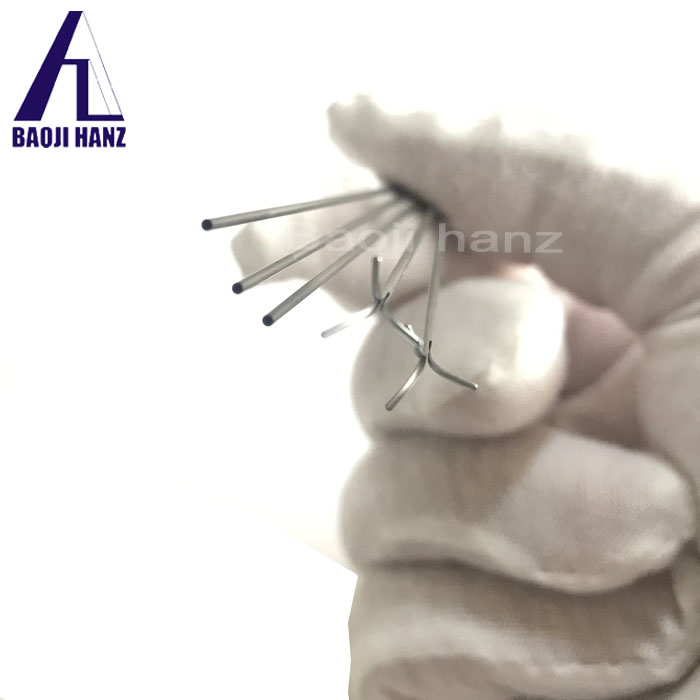
Nitinol foil


Material: superelastic nitinol
Chemical: 54.5%~57% Nickel balance titanium
Af temperature range: -10 degree ~ 100 degree
Thickness : 0.05mm min
width : 10mm
length : 500mm ~800mm
MOQ : 1 kgs
Surface: rolling
Brand : Baoji Hanz
Original: Shaanxi, China
Application:Dental orthodontics, surgery, medical, industry, research, robot and so on
Standard : ASTM F2063
Nitinol Foil for Medical & Industrial Applications - Ultra-Thin Precision Sheet with Customizable Af Temperature
Precision nitinol foil comes from Baoji Hanz Metal Material Co., Ltd. The base material is a superelastic nickel-titanium alloy (Ni 54.5–57.0 wt%, Ti balance). Runs are made to ASTM F2063-18 and GB 24627-2009. The thinnest gauge is 0.03 mm. Size tolerance stays at ±0.003 mm. Af temperature falls from -10°C to 100°C. Medical device development absorbs most of the output. Aerospace components and precision industrial work are other buyer uses. Orders start at 1 kg.
Technical Specifications
| Product name | nitinol foil or niti foils |
| Material | Superelastic nitinol |
| Chemical | 54.5%~57% nickel, balance titanium |
| Af temperature range | -10 degree ~ 100 degree |
| Thickness | 0.05mm ~ 0.3mm ( other thickness available to produce, please contact us) |
| Width | 10mm ~300mm |
| Length | 10mm~800mm |
| MOQ | 1kg |
| Surface | rolling |
| Brand | Baoji Hanz |
| Original | Shaanxi, China |
| Standard | ASTM F2063 |
ApplicationDental orthodontics, Surgery, Medical, Industry, Research, Robot and so on |
|

Niti strip packing1. packed with waterproof paper 2. put into plastic protect paper 3. put into carton or wooden case based on quantity |
|
|
|
Shipping method for nickel titanium foil1. small quantity lower than 100 kgs, we advise to use international express, such as FedEx, UPS, DHL and so on 2. Quantity higher than 100kgs, we advise to use airfreight to your closest airport 3. Quantity higher than 1000kgs, seashipping is advised. 4. If you have special requirement about shipping method, let us know, we will discuss based on your choice. |


Material Properties
This alloy works because of shape memory and superelasticity. Bend it over and over. Each time, it returns to its original shape. Spring parts rely on that. So do actuators. Any part that sees a cyclic mechanical load gets the same benefit.
Dimensional precision is what makes the foil format useful on the job. Thickness reaches as low as 0.03 mm. The tolerance stays at ±0.003 mm. Microdevices and precision instruments depend on that consistency. A tiny size shift can change how those parts function.
Fatigue and corrosion resistance keep parts dependable for the whole service life. Biocompatibility gives this alloy one more reason to get picked. The standards listed above are what those properties get judged against. Medical work fits too. Parts that touch human tissue can be made from it.
Thermal actuation relies on a phase-transformation temperature you can tune. Af can be set anywhere between -10°C and 100°C. Parts can be built to react at whatever threshold you pick. Thermal switches are one good fit. Sensors and actuated mechanisms are others.
Downstream processability is supported by the foil geometry. The material can be cut and stamped for micro-component fabrication without requiring specialized tooling beyond what is standard for thin-gauge precision materials.

Application Areas
Medical devices are one of the main use cases for this nitinol foil. You will find it in interventional device foils, micro-implant accessories, dental orthodontic components, and springs for minimally invasive instruments. In those places both fatigue resistance and biocompatibility are required.
Industrial and engineering applications cover thermal-actuated components, sensor springs, microswitches and flexible aerospace parts. Where a design calls for actuation driven by temperature, or for long mechanical cycling, this alloy fits well.
Research and robotics work uses the same phase-transformation behavior. Thin geometry helps. Steady transformation characteristics do too. That makes the material a good fit for flexible robotic joints. Shape memory structures and experimental actuators are other fits.

Manufacturing and Quality
All the steps run at our own plant. Vacuum melting starts the process, and final heat treatment ends it. Thanks to that, the chemical makeup stays consistent. Phase-transformation behavior also holds steady, batch after batch.
Chemical composition gets analyzed on every order. So does mechanical property testing. We also verify DSC phase-transformation temperatures. Ask us for the test reports and we will send them.
Both medical-grade and industrial-grade material are available. Packaging is shockproof and moisture-proof, with horizontal transport orientation to maintain foil integrity during shipping.
Customization Options for nitinol foil
Different applications require different specifications. The following parameters are available for customization:
- Thickness: down to 0.03 mm with tight tolerance control
- Af transformation temperature: tunable within -10°C to 100°C
- Surface treatment: pickled, bright polished, or ground
- Packaging method: adapted to your transport and storage requirements
- Dimensions: width and length adjustable within the ranges listed above

Why Work With Baoji Hanz
We handle the whole process in-house. Vacuum melting through heat treatment happens under our own roof. That way chemical composition and transformation temperature stay controlled at each stage. No outside processing steps are needed.
You can customize thickness, Af temperature, surface finish, and packaging. Raw material sheets come in one option. Formed parts come in the other. Which one fits depends on what your downstream requirements are.
Got questions about a certain application? Our technical support team can help. Picking the alloy is part of that help. Processing advice for this product comes with it too. Orders ship in 15–30 working days. The minimum order is 1 kg. Build a prototype with it, no big first batch needed.
Frequently Asked Questions
Q: What's the thinnest one you offer?
A: We go down to 0.03 mm. Dimension tolerance stays within ±0.003 mm. Need something else? Custom thickness from 0.03 mm to 1 mm is available on request.
Q: Can the Af transformation temperature be customized?
A: Yes. Af temperature settings run from -10°C to 100°C. Pick the number that fits your thermal actuation needs. What your application requires can also be your guide.
Q: Which standards does this material meet?
A: Production follows ASTM F2063-18 and GB 24627-2009. Chemical composition and phase-transformation performance are both covered by those standards.
Q: Can this material be used in medical devices?
A: Under the standards listed above, the alloy is cited for biocompatibility. A medical-grade product can be supplied. Chemical and mechanical test reports are available to help with your qualification process.
Q: What is the MOQ and lead time?
A: The minimum order quantity is 1 kg. Standard lead time is 15–30 working days depending on specifications and order volume.
Q: What quality documentation is available?
A: Every batch undergoes chemical composition testing, mechanical property evaluation, and DSC phase-transformation temperature testing. Documentation can be provided upon request.
Contact Us
Send your project specifications or technical questions to hztech05@hanztech.cn. We provide nitinol foil material information, test reports, and application support based on your requirements.
YOU MAY LIKE
_1767770162239.webp "medical nitinol rod")

_1751266472736.webp "nitinol bar")
_1794476532782.webp "nitinol alloy wire")

_1750148477057.webp "Superelastic Nitinol Wire with room temperature")